I stopped buying probiotics the day I read a study that made me feel like a fool.
For three years, I spent somewhere around $90 a month on probiotic capsules. The expensive kind — the ones that promise 50 billion CFU and come in dark glass bottles with clinical-sounding names. I swallowed them religiously every morning, convinced they were doing something for my skin, my digestion, my everything.
Then I came across a study from the Weizmann Institute of Science that changed my entire perspective. Researchers gave participants a high-quality, 11-strain probiotic blend and then did something most supplement companies would never want you to see: they performed endoscopies and colonoscopies to check whether the bacteria actually colonized the gut.
The result? A significant number of people were what the researchers called "resisters" — their existing gut microbiome simply expelled the probiotic bacteria like an uninvited guest. The capsules passed straight through. No colonization. No benefit. Just expensive waste.
That was the moment I started questioning everything I thought I knew about probiotics, prebiotics, and what my skin actually needed from the inside out.
———
Probiotics and Prebiotics: What's the Real Difference for Your Skin?
Let me simplify something that the supplement industry has made unnecessarily confusing.
Probiotics are live bacteria you consume — whether in capsule form or through fermented foods like yogurt, kefir, kimchi, and kombucha. The idea is to introduce beneficial microorganisms into your gut.
Prebiotics are the food that feeds the bacteria already living in your gut. Think of them as fertilizer for your internal garden. These are specific fibers and minerals found in foods like garlic, onions, leeks, asparagus, dandelion root, and mineral-rich ocean plants like sea moss. They aren't alive themselves — they're what keeps your existing microbiome alive and thriving.
Here's where it gets interesting for your skin: the connection between your gut bacteria and your complexion — known as the gut-skin axis — is now one of the most active areas in dermatological research. A comprehensive 2021 review in Microorganisms confirmed that gut dysbiosis is directly linked to acne, eczema, rosacea, and psoriasis through immune signaling, inflammatory pathways, and something called short-chain fatty acid (SCFA) production.
So the question isn't whether your gut bacteria affect your skin. That's settled science. The real question is: what's the most effective way to support those bacteria?
———
The Probiotic Pill Problem: Three Reasons Most Supplements Fail
I don't say this to be dramatic, but the probiotic supplement industry has a credibility problem that most consumers don't know about.
Problem 1: Stomach Acid Destroys Most Strains
Your stomach maintains a pH between 1.5 and 3.5 — acidic enough to dissolve metal. Most probiotic bacteria were never designed to survive that environment. Bifidobacterium species, one of the most commonly marketed probiotic families, show less than 1% survival through gastric transit without protective encapsulation. That means for every 50 billion CFU on your label, fewer than 500 million may actually reach your intestines alive.
There are exceptions. Lactobacillus rhamnosus GG has demonstrated over 70% viability after 3 hours in stomach acid, and spore-forming probiotics like Bacillus coagulans achieve over 90% survival. But these aren't the strains in most drugstore probiotics.
Problem 2: Your Gut Might Reject Them Anyway
Even when probiotic bacteria survive the acid bath, they face another obstacle: your existing microbiome doesn't want them there. The 2018 Weizmann Institute study I mentioned — published in Cell, one of the most prestigious scientific journals — found that colonization is highly personal. Your unique combination of gut bacteria and host gene expression determines whether you're a "persister" or a "resister."
No amount of CFU on a label can override your body's colonization resistance.
Problem 3: What's on the Label Isn't What's in the Bottle
Independent testing published in the International Journal of Pharmacy Practice found that only 27% of probiotic products that made specific claims about viable organisms actually met or exceeded their label claims. Nearly half didn't even list specific strain designations. Many report CFU counts at the time of manufacturing — not at expiration — meaning by the time you swallow them, the actual count could be dramatically lower.
———
The Stanford Study That Changed How I Think About Fermented Foods
In 2021, Stanford researchers led by Justin Sonnenburg, Erica Sonnenburg, and Christopher Gardner published a study in Cell that should have made front-page news.
They divided 36 healthy adults into two groups for 10 weeks. One group ate a diet high in fermented foods — yogurt, kefir, kimchi, kombucha, fermented vegetables — ramping up to six or more servings per day. The other group ate a high-fiber diet.
The fermented foods group saw something remarkable: 19 inflammatory proteins decreased significantly, including IL-6 (a major driver of systemic inflammation linked to acne and skin aging). Their gut microbiome diversity increased. And the effects were dose-dependent — the more fermented foods they ate, the greater the benefits.
The high-fiber group? No significant reduction in inflammatory markers. No increase in microbiome diversity during the study period.
This doesn't mean fiber is useless — the researchers noted the fiber group's microbiome may need longer to adapt. But it does mean that real, whole fermented foods deliver what most probiotic capsules promise but can't: a diverse introduction of live cultures in a food matrix that helps them survive digestion.
———
The Bacterial Strains Actually Linked to Clearer Skin
Not all bacteria are created equal when it comes to your complexion. Two strains stand out in clinical research:
Lactobacillus rhamnosus SP1 — A 2016 study from the University of Naples gave acne patients this specific strain (3 billion CFU daily) for 12 weeks. The result: L. rhamnosus SP1 normalized the expression of insulin-signaling genes (IGF1 and FOXO1) in acne-affected skin, with visible clinical improvement. A larger 2024 trial in Acta Dermato-Venereologica confirmed this — patients taking L. rhamnosus saw a 50% improvement on the Acne Global Severity Scale compared to 29% in the placebo group.
Even more striking: L. rhamnosus GG, given to pregnant mothers and then their infants, cut eczema rates nearly in half — 26% developed eczema versus 46% in the placebo group — and these benefits lasted at least four years.
Bifidobacterium longum — A double-blind study of 66 women with reactive, sensitive skin found that a B. longum-based cream significantly decreased skin sensitivity, reduced dryness, and strengthened the skin barrier within 29 days. In lab tests on human skin samples, it reduced vasodilation, edema, and TNF-alpha — a key inflammatory marker.
Here's the catch: both of these strains are challenging to deliver in capsule form. L. rhamnosus GG is one of the few acid-resistant strains, but most Bifidobacterium species get destroyed before reaching the colon. Which brings us back to the fundamental question — is there a better strategy?
———
Feed What You Already Have: Prebiotic Foods for Skin-Healing Bacteria
This is where my own approach shifted dramatically. Instead of trying to introduce new bacteria through supplements, I focused on feeding the beneficial bacteria I already had.
The science supports this. Prebiotic fibers — specifically fructooligosaccharides (FOS), galactooligosaccharides (GOS), and inulin — selectively nourish Lactobacillus and Bifidobacterium strains. A meta-analysis found that FOS supplementation significantly increased colonic Bifidobacterium counts, with higher doses (7.5-15g daily) and durations over 4 weeks showing the most distinct effects.
These bacteria then produce short-chain fatty acids (SCFAs) — acetate, propionate, and butyrate — that maintain intestinal barrier integrity, reduce systemic inflammation, and support skin barrier function.
The best prebiotic foods for your skin:
- Garlic, onions, and leeks — rich in FOS and inulin, the preferred fuel of Bifidobacterium
- Asparagus and Jerusalem artichoke — among the highest natural sources of inulin
- Dandelion root and chicory root — concentrated inulin sources (dandelion root is also a gentle liver supporter, which matters for whole-body detox)
- Mineral-rich ocean plants — sea moss provides 92 of the 102 minerals your body needs, many of which serve as cofactors for the enzymes your gut bacteria rely on to function
- Fermented vegetables — kimchi, sauerkraut, and fermented pickles deliver both prebiotics (the vegetable fiber) and probiotics (the live cultures) simultaneously
A 2022 clinical trial on 77 women found that prebiotic xylo-oligosaccharides reduced facial aging markers and decreased populations of acne-causing Cutibacterium while simultaneously increasing intestinal Bifidobacterium. Prebiotics were literally changing the skin by changing the gut.
———
Debunking the 5 Biggest Probiotic Myths
Myth 1: "More CFU = better results."
The Weizmann Institute research proved that colonization depends on your individual microbiome, not dose. A 100 billion CFU capsule in a "resister" does nothing. A well-matched strain at lower doses in a "persister" can transform gut health.
Myth 2: "All fermented foods are probiotic."
Not quite. Foods that are pasteurized after fermentation (like most store-bought kombucha and pickles) contain no live cultures. Look for "raw" or "unpasteurized" on labels, or make your own.
Myth 3: "Probiotics work overnight."
Clinical trials consistently show 4-12 weeks for measurable results. The Stanford fermented foods study ran 10 weeks. The L. rhamnosus acne trial was 12 weeks. If someone promises clear skin in a week from a probiotic, that's marketing, not science.
Myth 4: "You only need probiotics OR prebiotics."
You need both — but the ratio matters. Most people benefit far more from increasing prebiotic foods (fiber, minerals, fermented vegetables) than from adding another supplement capsule. Think of it this way: planting seeds in dead soil doesn't grow a garden. You need to enrich the soil first.
Myth 5: "Gut health only matters for digestion."
A landmark study on rosacea found that patients were 13 times more likely to have small intestinal bacterial overgrowth (SIBO). When the gut imbalance was treated, cutaneous lesions cleared completely in the majority of patients and stayed clear for at least 9 months. Your gut is talking through your skin — constantly.
———
What Actually Worked for My Skin (and What I Tell My Clients)
After years of experimenting, here's what I've landed on — and what I recommend in my practice:
- Start with a gut reset. Before adding anything, clear out what's not serving you. A targeted gut cleanse can help rebalance bacterial populations and reduce the inflammatory load that shows up on your skin.
- Build your prebiotic foundation. Load your diet with garlic, onions, leeks, asparagus, and fermented vegetables. Add mineral-rich sea moss to support the enzymatic processes your gut bacteria depend on.
- Get your probiotics from food, not capsules. Six servings of fermented foods daily — the Stanford protocol — consistently outperforms supplementation in research.
- Support from the outside in, too. While your gut heals, your skin barrier needs direct nourishment. A tallow-based cream provides the fatty acids your skin recognizes and absorbs naturally — it's what I use nightly.
- Give it 12 weeks. That's the timeline the clinical trials support. Not 12 days. Track your skin with weekly photos so you can see the gradual shifts that are easy to miss day-to-day.
The biggest lesson I've learned — both personally and professionally — is that clear skin isn't about adding more products. It's about creating the internal environment where your body can do what it already knows how to do.
———
Ready to Start From the Inside Out?
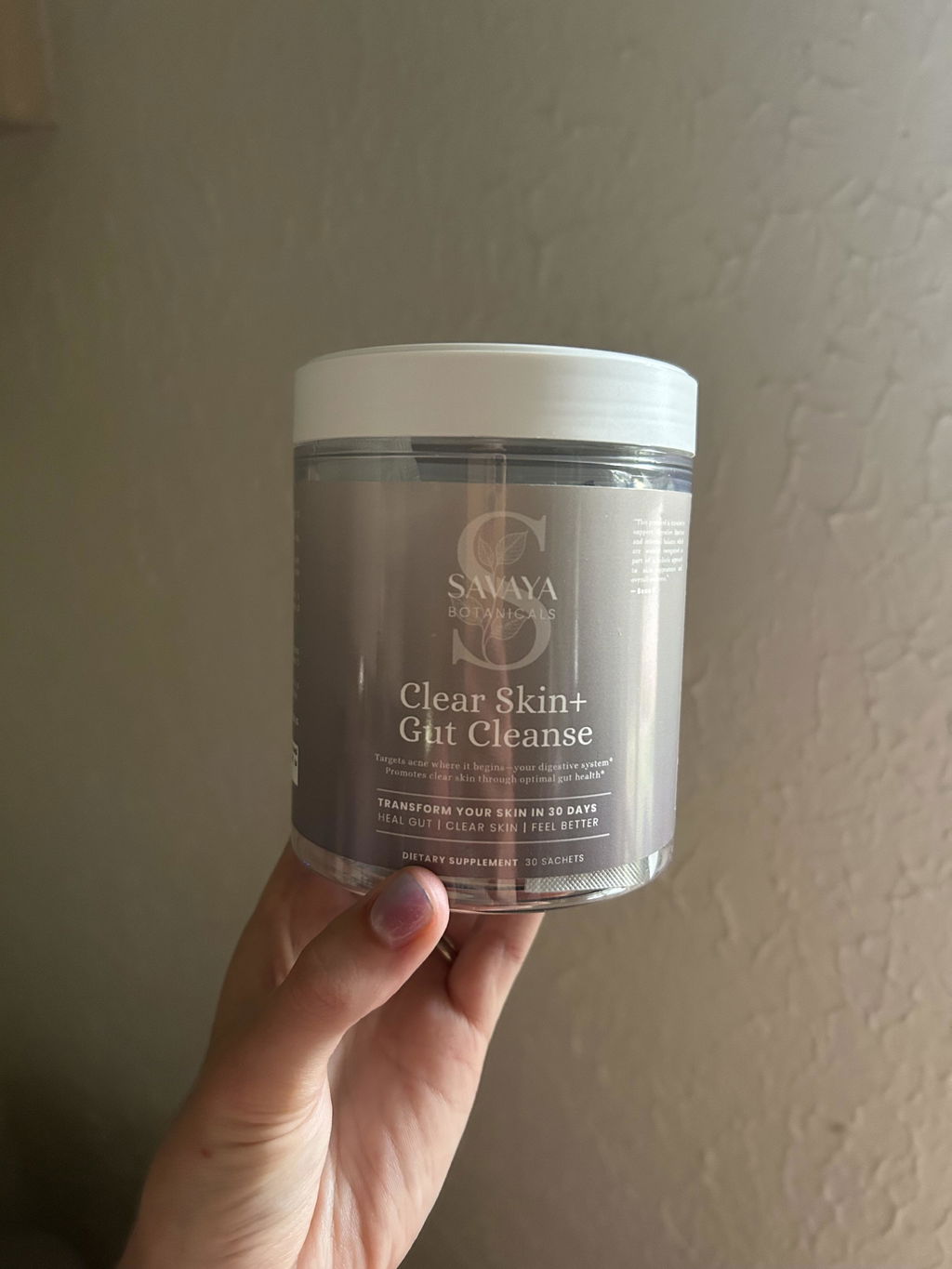
If you're tired of guessing which supplements actually work, Clear Skin+ Max Detox is a daily acai blend that helps support healthy digestion and skin — designed around the same research I've shared in this article. No more throwing money at capsules that your stomach acid destroys before they do anything.
———
Frequently Asked Questions
Do probiotics or prebiotics work better for clearing acne?
Research suggests prebiotics may be more effective for long-term skin health than most probiotic supplements. A 2021 Stanford study found that fermented foods (natural probiotics) reduced 19 inflammatory markers, while prebiotic-rich fiber feeds existing beneficial bacteria like L. rhamnosus and B. longum that are directly linked to clearer skin. Most probiotic capsules lose the majority of their bacteria to stomach acid before reaching the gut.
Why do most probiotic supplements not work for skin?
Three main reasons: stomach acid destroys most strains before they reach the intestines (Bifidobacterium species show less than 1% survival without protective coating), a 2018 Weizmann Institute study found many people are natural "resisters" whose microbiome expels supplemental bacteria, and independent testing shows only 27% of products actually contain what their labels claim.
What bacterial strains are scientifically proven to improve skin?
Lactobacillus rhamnosus SP1 improved adult acne by normalizing insulin-signaling genes in a 12-week clinical trial. Bifidobacterium longum reduced skin sensitivity and strengthened the skin barrier in a 66-person double-blind study. L. rhamnosus GG cut eczema rates nearly in half when given to at-risk children — benefits that lasted at least 4 years.
What prebiotic foods help clear skin naturally?
Foods rich in fructooligosaccharides (FOS) and inulin — including garlic, onions, leeks, asparagus, chicory root, and dandelion root — significantly increase Bifidobacterium and Lactobacillus populations in the gut. These bacteria produce short-chain fatty acids that reduce systemic inflammation and support skin barrier function through the gut-skin axis.
How long does it take for gut health changes to show on skin?
Clinical trials show measurable skin improvements from gut-focused interventions within 4 to 12 weeks. The Stanford fermented foods study observed significant inflammatory marker reductions within 10 weeks. L. rhamnosus trials showed clinical acne improvement at 12 weeks, while prebiotic supplementation increased beneficial gut bacteria within 4 weeks.