I Waited Years for My Hormonal Acne to Go Away on Its Own — Here's What I Learned

Key Takeaways
- Hormonal acne can persist from the teenage years through your 20s, 30s, and beyond without ever fully resolving.
- Androgens, the same hormones active during puberty, can keep influencing oil production well into adulthood.
- Simply waiting it out is not a guaranteed fix — many women report breakouts continuing for a decade or more.
- The gut and skin are connected through what researchers describe as the gut-skin axis, not hormones alone.
- Zinc and magnesium are nutrients the body relies on for normal skin and immune function, per NIH's ODS.
For some women, hormonal acne fades with age; for many others, it doesn't — it can continue from the teenage years into your 20s, 30s, and beyond. Waiting it out isn't guaranteed to work, which is why looking at underlying factors like gut health matters.
Does Hormonal Acne Go Away On Its Own?
Not always. Hormonal acne can improve for some women as they get older, but for many it lingers well past the teenage years and into adulthood. Androgens, the hormones most active around puberty, can keep influencing oil production for decades, which is why 'just wait' doesn't work for everyone.
I used to tell myself the same thing every single year: “This is the year it finally clears up.” I said it at 16. I said it at 22. I was still saying it at 29.
Nobody ever really explains why hormonal acne sticks around for some of us and not others. Puberty is supposed to be the reason — and then it's supposed to end. For a lot of women, it doesn't.
Androgens, the same hormones that ramp up oil production during puberty, don't just switch off once you're past your teens. They keep playing a role in how much oil your skin produces well into your 20s, 30s, and sometimes later.

My Acne Timeline: Puberty, My 20s, and Still Here in My 30s
My hormonal acne started around age 13 and never fully cleared — it just changed shape, moving from my forehead as a teenager to my jawline and chin by my late 20s. I spent years assuming it was a phase I'd eventually 'grow out of.'
By middle school it was forehead breakouts. By college, it had migrated to my cheeks. By my late 20s, it had settled into the jawline-and-chin pattern so many women describe as “hormonal” acne — deep, tender, and stubborn.
Every dermatologist visit came with some version of the same reassurance: “This usually calms down with age.” I believed it through my early 20s. I was still hoping for it in my late 20s.
By 30, I stopped waiting for a switch to flip and started actually asking why it hadn't.

Why 'Just Wait It Out' Didn't Work For Me
Waiting relies on the assumption that hormonal acne is purely a puberty issue that resolves on its own timeline. For many adult women, ongoing androgen activity, stress, and other factors — not just the calendar — keep influencing breakouts, so time alone isn't always what changes things.
I want to be clear about something: I'm not talking about the kind of breakout that shows up like clockwork the week before your period, or a specific diagnosis some women eventually get. Those are their own stories.
Mine was different — a low-grade presence that never fully cleared even between “flare-ups.” I tried cutting dairy for a few months. I tried retinol. I tried a new pillowcase more times than I'd like to admit.
Nothing was wrong with any of those things. They just weren't addressing whatever was keeping the cycle going underneath my skin.

What Finally Made Me Look Beyond My Skin
The shift happened when I stopped treating my skin as an isolated problem and started paying attention to gut health and the body's natural detoxification pathways. Skin is often described as a reflection of what's happening internally, so I began supporting those systems instead of only my skin's surface.
Somewhere around year fifteen of this, I read something that reframed everything: skin is sometimes described as a mirror of what's going on inside the body. That didn't mean my skincare routine was wrong. It meant it might not be the whole picture.
I started paying more attention to digestion, hydration, and how sluggish or “off” I felt day to day — things I'd never once connected to my face.
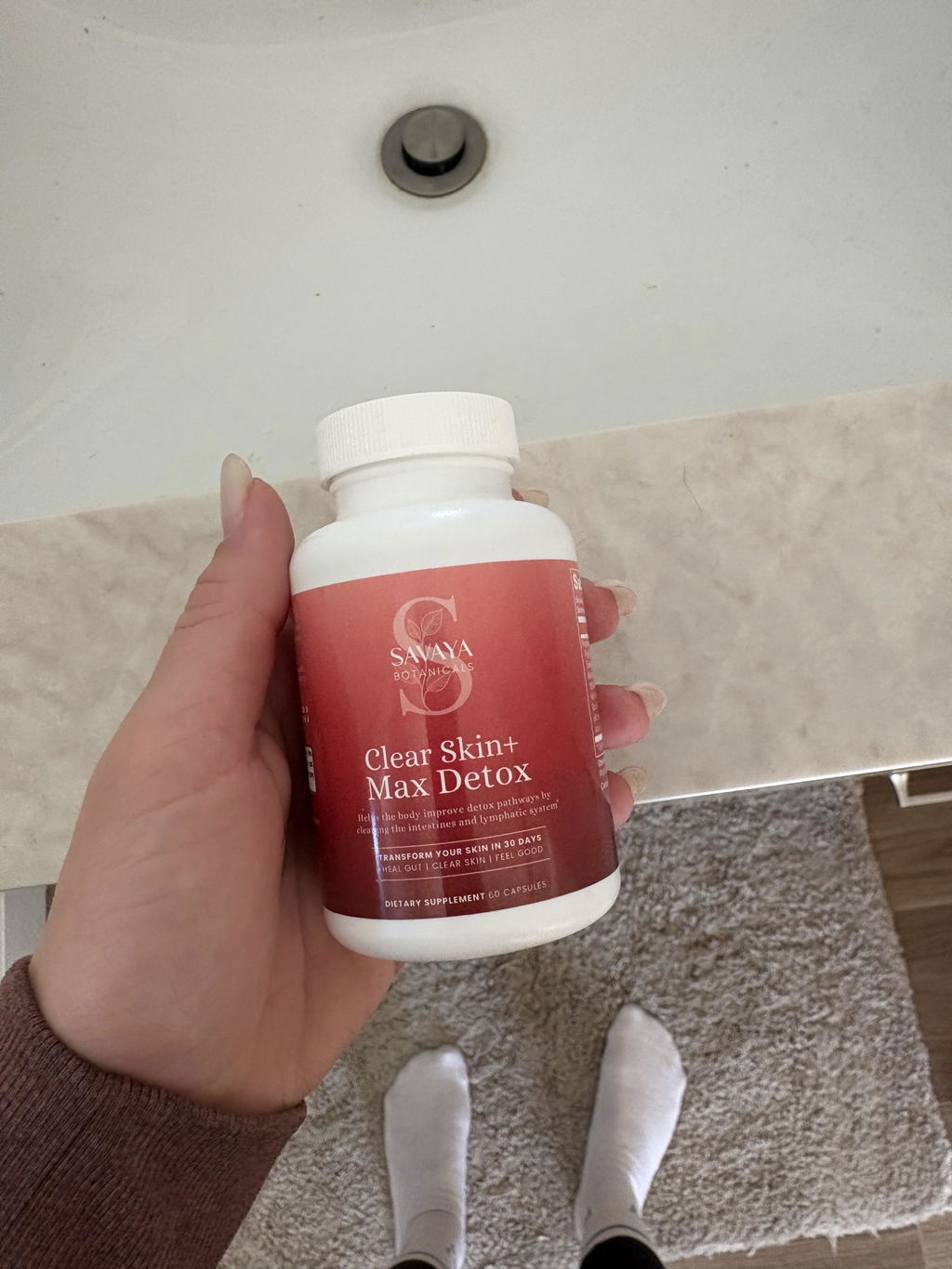
That's around when I started using Max Detox, a daily acai-based blend meant to support the body's natural detoxification pathways and gut health, alongside the basics I was already doing. I didn't expect it to be a fix on its own, and it isn't marketed as one — it was one more input into a system I'd been ignoring for over a decade.

What Changed When I Started Supporting Gut Health and Detox Pathways
I can't point to a single before-and-after photo, and I'm wary of anyone who can without real evidence. What I can say is that supporting digestion, hydration, and detoxification became a consistent daily habit, and it's one piece of a broader routine I still use alongside sleep, stress management, and skincare.
I'm not going to tell you this “fixed” my skin, because that's not how any of this works, and I'd be lying. Chronic hormonal acne is rarely one-variable.
What I can say honestly: paying attention to gut health and giving my body consistent support for its own detox processes became a habit I kept, not a phase I abandoned after two weeks like the dairy-free thing.
The nutrients your body relies on for normal skin function and immune health — like zinc and magnesium — are ones most of us don't think about until something's clearly off.
That's the piece I'd been skipping for fifteen years: not a new cleanser, but the basics my body needed to function well from the inside.

What To Do If Your Hormonal Acne Has Never Fully Gone Away
Start with what's free: track your breakouts against your cycle and stress levels for several weeks, audit your sleep and hydration, and note dietary patterns without eliminating everything at once. Small, trackable changes reveal more than waiting ever will, and they build a foundation before adding anything else.
Before you spend money on anything, do this first:
- Track breakouts on a simple calendar alongside your cycle, sleep, and stress for a few weeks — patterns tell you more than memory does.
- Look at hydration and fiber intake, both of which play a role in normal digestion and elimination.
- Note, without eliminating everything, whether dairy, sugar, or alcohol seem to line up with your worst weeks.
- Prioritize sleep consistency for a stretch and see what you notice.
- If breakouts are severe, painful, or cystic, loop in a dermatologist — some patterns are worth a professional opinion, not just a routine change.
Once you've got a baseline, that's where daily support for gut health and detoxification pathways can fit in as one piece of the routine — which is the role a product like Max Detox is designed to play, alongside the habits above, not instead of them.

So — Does Hormonal Acne Ever Actually Go Away?
Sometimes, yes — plenty of women do see their hormonal acne fade with age. But if yours hasn't, that doesn't mean nothing will change; it usually means there's more happening beneath the surface than hormones and time alone, and it's worth looking at the fuller picture instead of waiting longer.
I don't have a tidy ending where I tell you my skin is now flawless. What I have is fifteen-plus years of data on myself, and a much better understanding of why “just wait” was incomplete advice.
If you're still breaking out in your 30s, 40s, or beyond, you're not broken, and you're not unusual. You're just someone who might need to look past the calendar.
Start with the free stuff. Track it, adjust the basics, and give your body real support — including the systems, like digestion and detoxification, that don't show up in a mirror.

See if Max Detox is right for you
Frequently Asked Questions
How long does hormonal acne usually last?
There's no fixed timeline — some women see hormonal acne fade in their late teens or 20s, while others deal with it into their 30s and 40s. Duration varies by individual hormone patterns, stress, sleep, and overall health, which is why 'it'll pass' isn't a reliable prediction for everyone.
Can hormonal acne go away without any treatment?
For some women, yes — hormones stabilize with age and breakouts lessen on their own. For others, acne persists because ongoing factors like androgen activity, stress, or diet keep contributing to it, so treatment-free improvement isn't guaranteed and often depends on addressing those underlying contributors.
Does hormonal acne get better after your 20s?
It can, but not universally. Many women notice improvement as hormone levels shift with age, while others continue experiencing breakouts into their 30s and 40s. There's no single pattern, which is part of why chronic hormonal acne often needs a broader look than just 'waiting it out.'
What causes hormonal acne in adult women?
Hormonal acne in adults is generally linked to androgen activity, which can increase oil production in the skin. Stress, sleep, diet, and gut health may also play a role for some women, which is why a single cause rarely explains why breakouts persist for so long.
Is adult hormonal acne different from teenage acne?
They share a hormonal driver — androgens — but often show up differently. Teenage acne tends to cluster on the forehead and nose, while adult hormonal acne is frequently concentrated on the jawline and chin, and tends to be deeper and more cystic in texture.
This content is for general wellness and educational purposes and is not medical advice. These statements have not been evaluated by the Food and Drug Administration. This product is not intended to diagnose, treat, cure, or prevent any disease. Consult your healthcare provider before starting any supplement, especially if you are pregnant, nursing, or managing a health condition. Individual results vary.